Showing posts with label books. Show all posts

Monday, March 30, 2009

The Screwtape Letters

I finished it along time ago, loved it, and have not had time since to sit down and blog on it, until now.

The storyline is fairly simple, and probably pretty well know, a series of letters from an elderly and experienced devil, Screwtape, to his nephew, Wormwood, during the period of the latters first attempt at temptation. Lewis uses this rather unusual basis to produce an absolutely brilliant book. Below is one of my favorite quotes:

He (God) is prepared to do a little overriding at the beginning. He will set that off with communications of His presence which, though faint, seem great to them, with emotional sweetness, and easy conquest over temptation. But He never allows this state of affairs to last long. Sooner or later He withdraws, if not in fact, at least from their conscious experience, all those supports and incentives. He leaves the creature to stand up on it's own legs- to carry out from the will alone duties which have lost all relish. It is during such trough periods, much more than during the peak periods, that it is growing into the sort of creature He wants it to be. Hence the prayers offered in such a state of dryness are those which please Him best. We can drag our patients along by continual tempting, because we design them only for the table, and the more their will is interfered with the better. He cannot "tempt" to virtue as we can to vice. He wants them to learn to walk and must therefore take away his hand: and if only the will to walk is really there he is pleased even with their stumbles. Do not be decieved Wormwood. Our cause is never more in danger than when a human, no longer desiring, but still intending, to do our Enemy's will, looks roundupon a universe from which every trace of Him seems to have vanished, and asks why he has been forsaken, and still obeys.

Monday, April 21, 2008

The Robe

Having seen the movie of The Robe numerous times and reading a script adaptation, it seemed high time to read the book. I loved it.

It's a story about the centurion who oversaw the crucifixion of Christ, and who won His robe while gambling. The robe, after driving him mad for several months, ends up bringing him back to Palestine. Touring the area around the Sea of Galilee, he hears many stories of the strange doings of Jesus. The journey culminates beautifully in his conversion to Christianity. The story goes on, but I have no wish to spoil the ending.

Oddly enough (especially odd if you know me) the romance in this story was one of my least favorite elements. The part I loved was in Israel. The centurion, Marcellus, begins as something of a sceptic and manages to find "realistic" explanations of the first couple of miracles of which he is told. But then he hears the story of Lydia. His change of mind and heart is exquisitely handled, and the outsiders point of view through which the reader hears of Jesus creates a story well worth reading.

Friday, February 08, 2008

Judith of France By Margaret Leighton

On the reccomendation of Algernon and his sister I recently read two books, the titles of which are Judith of France and Journey for a Princess. They were both very good, although I am still unable to decide which I like better, and I shall hereby attempt to write a post about them. Judith of France first, Journey for a Princess, hopefully to follow soon.


Judith of France was the great-granddaughter of Charlemagne the Great. However that magnificent king's line is no longer great. The sons of Charlemagne now wage petty wars between themselves, and it is for this reason, and for the pursuit of wealth and prestige, that Judith's father arranges a marriage for her. Heartlessly, he betrothes high-spirited, still teenaged Judith to the sixty year old king of England, Aethulwulf. Already weighed down with this news, Judith is told by the Archbishop of Reims that it is his belief that she is irrevocably doomed to follow in the footsteps of her grandmother, that is to cause strife and even war; "father against son, brother against brother". Frightened, confused and disheartened she brings the story to her tutor, bringing about one of my favorite scenes, where the latter tells her in much better words then mine that no man's future is set in stone, that choices can and must be made and that, with God's help, she can do what is right. Vastly relieved, she makes a vow never to be the cause of strife between family or friends. This vow leads her to many tough decisions and, which shape her story into an unusual, thought-provoking and satisfying tale.
WARNING: due to Judith's vow the story contains some slightly mature content.

Friday, January 25, 2008

I've Been Tagged

A. Lynch tagged me for this meme. What fun!

1. Pick up the nearest book (of at least 123 pages).
2. Open the book to page 123.
3. Find the fifth sentence.
4. Post the next three sentences.
5. Tag five people.

"Of which he was the patron. I was there
From college visiting the son- the son
A Walter too with others of our set,"

(From Poems of Tennyson the poem is The Princess; A Medley)

I Tag:

All of the ChesterTeens.

Thursday, October 25, 2007

Manalive

Chesterton's ability to weave astonishing paradoxes, marvelous truths and perfect humor into a engaging, educating and incredible story is astounding, and in Manalive he certainly puts his gifts to work.

Innocent Smith is a mystery. Literally blown in to the story by a great wind, he begins climbing trees, spouting nonsensical English, retrieving hats and creating a general feeling cheerfulness as soon as his feet touch ground. In the course of the next few pages, this atmosphere becomes more pronounced and by the middle of chapter four all of the principle characters are engaged to one and other. Thus a happily-ever-after ending seems just around the corner. However before that can become a reality we meet several crime-specialists who introduce a startling series of accusations which question the Innocence of Inoccent. In a makeshift courtroom, the charges of murder, burglary, desertion and polygamy are brought to the doorstep of Mr. Smith. His freedom seems, to put it midly, lost. But, as one of my friends once said, "surprises are the hallmark of the Sage of Beaconsfield*", and as someone who I would greatly like to call my friend once said "things are not always as they seem." Although none of the evidence against Smith is false, he is indeed as blameless as his name suggests. As we learn near the end of the book "he has broken the conventions but he has kept the commandments."

However, the basic storyline can only give you the faintest of ideas of how hilarious and how true and thoughtful this marvelous book is. If you don't own a copy, you can read it here. Just read a few paragraphs whenever you have a spare minute, it is well worth your time.
*Chesterton

Tuesday, September 25, 2007

The Wide Horizon

In this second installment of the Texas Panhandle saga, Loula Grace Erdman tells the story of the middle girl, timid, artistic Katie.

Melinda is recently married and living in Amarillo 30 miles away with Dennis Kennedy, a name familiar to those who have read the first in this series, The Wind Blows Free. Before Katie can quite accustom herself to life without Melinda, word comes that grandmother has been seriously injured in a fall, and mama must go back to East Texas to care for her. This leaves Katie in charge, Katie, who had always relied on these two for initiative and now must take the lead. Keeping house for papa, her two older brothers and her younger sister, is not an easy task. And besides this arrangment has delayed Katie's entrance into the highschool back in East Texas, the school that will perfectly fit her interests. But despite these difficulties, the year progresses, and so does Katie's ability. Overcoming her baking troubles with the help of her younger sister, taking care of two small children in addition to her own family and fighting her way through a fierce blizzard are but a few of the difficulties Katie must try her hand at. But, like her older sister Melinda, Katie doesn't give up and finally conquers her fears and inablilities in this story of pioneer life in the Texas Panhandle.

Thursday, September 13, 2007

Fabre's Book of Insects

After an approximately year long endeavor, I finally finished reading Fabre's Book of Insects. Jean Henri Fabre chronicles the lives and adventures of a number of different types of insects. His reader will become acquainted with the scarab beetle who rolls his one and only kind of fare in a perfectly shaped ball before him as he traverses difficult terrain then stores it in his lair. The reader will follow out most learned and interesting guide into the nests of bees of numerous descriptions and into the wonderfully crafted, and actually used home of the locust. He will explorethe secrets of the lives of murderous parasites and the mysterious burrowings of Capricorn grub. These and many more adventures await he who reads Fabre's Book of Insects.
Written by a French Catholic Naturalist, I found this book rather slow, but still very interesting.

Wednesday, July 25, 2007

To Kill a Mockingbird- Study Questions

It is not the main point of this post to tell you why this blog has been so sadly neglected. But a brief explanation should be given. The past week and a half or so has been crazy. Springfield, Schoenstatt, Youth Group, Harry Potter 5 (the movie) and Harry Potter 7 (the book) have made blogging rather lighter then usual. Speaking of Harry Potter 7, there is a very interesting discussion going on here, and at Flying Stars another can be found, but be warned all ye who have not yet read the book, spoilers are brought up numerous times.

That said 'tis time for study questions. To Kill a Mockingbird was one of our teen discussion books about three months ago, and just today I finally finished answering the study questions for this book. Nota Bene, a number of my answers come from our discussion group, not all of them are my own.

1. From whose point of view is this story told?
The story is told from the point of view of Jean Louise Finch, better known as Scout.

Who do you think the author chose this character instead of Jem?
In Scout's narrative there is a childlike simplicity that gives the book a character which would be much less evident in Jem's less childish story.

2. How does Jem look on his father early in the book? (give at least one example)
Although Jem loves his father, he thinks that he is not very good at anything, as in the incident of Jem's annoyance with Atticus for not playing football.

Does his view seem to change by the end?
Yes

If so, how?
In the course of the story, Jem sees his father doing things, e.g. the mad dog incident and the court scene, which show him that his father is good, very good, at many things, things that are actually more important then football and such. Many times throughout the book Jem sees more of his father's character, and learns that it is strong and very good, thus Jem comes to respect and admire his father.

3. Who is Mrs. Dubose?
Mrs. Dubose is the cranky neighbor lady who is always hurling insults at passersby.

Why do the children hate her so?
The children hate her because of the insulting things she says about them and especially the nasty comments concerning Atticus and his court case.

When Atticus realizes how angry Jem is over Mrs. Dubose's comments, he says: "You just hold your head high and be a gentlemen. Whatever she says to you, it's your job not to let her make you mad." What does this comment tell you about Atticus's children?
I think it illustrates, as is seen in other places as well, that Atticus is rather passive ordinarily yet can make up his mind and stick to it remarkably well. I think that is largely because he doesn't get angry and stubborn about every little thing. The question of how Atticus tries to raise his children comes up in another question so I won't go into it again.

How did the children end up helping Mrs. Dubose?
The children helped Mrs. Dubose by reading to her and thus distracting her from the pain that ensued when she stopped taking drugs.

4. In chapter 11, Atticus and Scout briefly discuss why he feels he must defend Tom Robinson. Atticus says, "The one thing that doesn't abide by a majority rule is a person's conscience." Explain what he mans by this and how this belief causes conflict for him within the community.
Atticus means that although everyone else may be against what's right, a person's conscience (if it is well formed) will still tell you the what it right, although it may conflict with what the others say. Since Atticus followed his conscience, thus following God, rather then the popular prejudice, some of the people of his town were very angry, in a few cases, violent.

5. How was the Finch's family life different than others they knew?
Atticus let his children have a pretty free rein to do a good deal of what they wanted to, not whatever they wanted to. Also the lack of a mother in the household made their family life different then the typical one.

How did other people view the way their father was raising them?
Most other people viewed Atticus's methods with a critical eye, they thought he was far to lenient with his children.

What do you think of Atticus Finch as a father?
I think Atticus Finch is a wonderful father. He taught by example as well as by telling his children what is right and so he provided them with a better sense of right and wrong.

6. Why was Tom Robinson's case so hopeless?
Tom Robinson's case was so hopeless because of the great prejudice against Negroes in the south at that time.

What did it say about the judge that he asked Atticus Finch to represent Tom Robinson? The fact that the judge chose Atticus Finch to represent the man who was sure to be condemned shows that the judge cared about justice, and Tom Robinson and wanted to be sure that he had a fair trial.

7. What is the meaning of the title of the book?
To put it simply the meaning of the title of the book is that it is a sin to kill a mockingbird as we see in the story so named.
Why is it a sin to kill a mockingbird?
It is a sin to kill a mockingbird because a mockingbird does no harm to anyone, but merely sings its beautiful song.

Who is the mockingbird in the book? (Feel free to mention more than one if you think it appropriate).
Tom Robinson is the most obvious example but Arthur (Boo) Radley also illustrates the characteristics of the mockingbird.

Given this title, what do you think the author would consider to be the most important point of the book?
I don't know that I can pinpoint one particular most important point among the many themes present in the book including: love, hope, justice (shown partly through an excess of injustice) and courage.

8. What do you think this book might teach parents about raising children in difficult times and under difficult circumstances?
To Parents raising children under difficult circumstances To Kill a Mockingbird would show them, and hopefully inspire them to teach their children by their actions and not just their words. It might also show them that while they can't shield their children from everything, they can help them to overcome the difficulties thrust at them.

Wednesday, July 11, 2007

From Orthodoxy By GKC

The whole secret of mysticism is this: that man can understand everything by the help of something he cannot understand.

(Chap. 2 The Maniac)

Friday, June 29, 2007

St. Paul


Since today is the feast day of Sts. Peter and Paul, and since Paul one of my favorite saints, I think a post is in order. So, St. Paul's conversion story, in his own words (Acts 22:3-21):


I am a Jew, born at Tarsus in Cilicia, but brought up in this city, at the feet of Gameliel, taught according to the truth of the law of the fathers, zealous for the law, as also all you are this day: Who persecuted this way unto death, binding and delivering into prisons both men and women, As the high priest doth bear me witness and all the ancients. From whom also receiving letters to the brethren, I went to Damascus, that I might bring them bound from thence to Jerusalem to be punished. And it came to pass, as I was going and drawing nigh to Damascus, at mid-day, that suddenly from heaven there shone round about me a great light: And falling on the ground, I heard a voice saying to me: Saul, Saul, why persecutest thou me? And I answered: Who art thou, Lord? And he said to me: I am Jesus of Nazareth, whom thou persecutest. And they that were with me saw indeed the light: but they heard not the voice of him that spoke with me. And I said: What shall I do, Lord? And the Lord said to me: Arise and go to Damascus; and there it shall be told thee of all things that thou must do. And whereas I did not see for the brightness of that light, being led by the hand by my companions, I came to Damascus, And one Ananias, a man according to the law, having testimony of all the Jews who dwelt there, Coming to me and standing by me, said to me: Brother Saul, look up. And I, the same hour, looked upon him. But he said: The God of our fathers hath preordained thee that thou shouldst know his will and see the Just One and shouldst hear the voice from his mouth. For thou shalt be his witness to all men of those things which thou hast seen and heard. And now why tarriest thou? Rise up and be baptized and wash away thy sins, invoking his name. And it came to pass, when I was come again to Jerusalem and was praying in the temple, that I was in a trance, For thou shalt be his witness to all men of those things which thou hast seen and heard. And now why tarriest thou? Rise up and be baptized and wash away thy sins, invoking his name. And it came to pass, when I was come again to Jerusalem and was praying in the temple, that I was in a trance, And saw him saying unto me: Make haste and get thee quickly out of Jerusalem: because they will not receive thy testimony concerning me. And I said: Lord, they know that I cast into prison and beat in every synagouge them that believed in thee. And when the blood of Stephen thy witness was shed, I stood by and consented: and kept the garments of them that killed him. And he said to me: Go, for unto the Gentiles afar off will I send thee.

Photo by: mharrsch

Thursday, May 10, 2007

Red Falcons of Tremoine By Hendry Peart

At fifteen Leo, living at the Abbey of St. Michael in England in the 13th century, knows nothing about his past or parentage. The Abbot of the said Abbey alone knows the boy's history but tells him nothing until the heir of the house of Wardlock is killed in the crusades. Then after receiving permission from Sir Maurice (the current lord of Wardlock) the Abbot tells Leo that he is the heir not only to the house of Wardlock but also the heir to their traditional enemy the house of Tremoine. He is the child of a Romeo and Juliet sort of marriage, his father killed by his brother in law, Rolf and his mother dead soon after entrusting her son to the care of the Abbott. Much excited by this news, Leo leaves the Abbey and goes to live with his kind grandparents, Sir Maurice of Wardlock and his wife. Several happy months pass in the company of his grandparents. Then Leo visits the Abbey. Finding the Abbot absent he travels on to the place where his parents were married. There he is forcefully captured by his Uncle Rolf and forced to become heir to the lands of Tremoine. The Tremoine Temper is strong in both Leo and Rolf and clashes of will are frequent. Yet Leo's gentle side, prominent when not provoked, soon makes him friends among the castle residents and perhaps it is softening Rolf as well. In Rolf's castle unfolds an engaging tale of courage and forgiveness.

Tuesday, May 01, 2007

Back to Liber, Parma or whatever you want to call a book

Well I finally got myself into Eight Cousins by Louisa May Alcott and finished it rapidly, enjoying every minute of the time spent on it. This delightful story chronicles the entrance (and the time of about a year following it) of a shy orphan, Rose, into her large extended family, whom she had had virtually no contact with in her past life. The family she soon becomes acquainted with includes six lovable and attentive aunts, three kind uncles and seven delightful and rather rowdy boy cousins. After several weeks of unsuccessful attempts by the aunts to cheer up the downcast Rose, her uncle, Dr. Alec arrives. His prescription is many fold but includes no pills, but rather plenty of exercise and other unladylike activities. However odd it seemed to the aunts his method bore increasingly marked and marvelous results, including a wonderful story which I highly recommend.

Thus her health increases rapidly as does her good character. From sacrificing a day of fun for the pleasure of a maid or her precious earrings in order to keep her cousins from bad habits to being peacemaker and encourager to the seven boys Rose's adventures are sure to be interesting, amusing, touching, teaching or any mix of the above. A number of thought-provoking ideas and theories are held within the 200 and more pages in the form of very quotable utterances of the characters or commentary on the scene. To illustrate my point I quote "... in helping seven lads you are unconsciously doing much to improve one lass... "

Okay, enough blabbering for now... I don't want to bore you too badly.

Tuesday, February 13, 2007

Random Anne Facts

Over the past week or so I have spent all my available time (almost) with the Anne of Green Gables series. Previously I had not got past the first book!! Now I am on the fifth and am loving it (how could it be otherwise?)!!!! Perhaps one of these days, maybe when I'm done with the seventh, I'll write a real post on them but now I just wanted to mention a few random things in and about the books that tickled my fancy.

First, on the covers of Anne of the Island and Anne's House of Dreams, she is wearing a pink dress!!!!!! Unfortunatly I couldn't find the exact location, but I know there is a place in the first book where Anne laments that although pink is a lovely color she can never wear it due to her red hair! Hmmm, I wonder if the illustrator actually read the books.

Secondly, Mark Twain apparently was a fan of this series. He described it as "the sweetest creation of child life yet written."

Finally, from the actual book. The background doesn't matter much, Sally is a friend of Anne preparing for her wedding and her meddlesome Aunt is having a conversation with the two of them. My mom, brother and I had a good laugh over this:


"The quality of mercy is not strained." giggled Sally, wriggling into her dinner dress.
"Don't quote the Bible flippantly" rebuked Aunt Mouser "You must excuse her Miss Shirley, she just ain't used to being married yet."

Tuesday, January 30, 2007

Bible Quiz

You know the Bible 100%!

Wow! You are awesome! You are a true Biblical scholar, not just a hearer but a personal reader! The books, the characters, the events, the verses - you know it all! You are fantastic!

Ultimate Bible Quiz
Create MySpace Quizzes

Me a biblical scholar???? Yeah right. They're all multiple choice!

Oh well, I liked the quiz anyway.

Hat tip- Studeo

Thursday, November 16, 2006

Thankful Thursdays

1. The Catholic faith.
2. My family and friends, I love chatting with them about, well.... anything and everything!
3. Books, reading time, authors like Chesterton, Tolkien, Lewis, Austen, Regina Doman, Hilda Van Stockum, Shakespeare etc. etc. etc. (Does that count as one?)
4. Blogger. The blogs have been so much fun, making new friends and keeping in touch with old. And learning things all the time, particularly about Chesterton.
5. Discussions with our homeschool friends.
6. Dr. Thursday's posts, particularly his Thursday posts on ACS.
7. The camera, I'm enjoying it more and more.
8. Being able to listen to stories almost anytime. Thanks to multiple audio players in our house.
9. Shakespeare parties. We get together with a bunch of friends, and read a Shakespeare play together, we have SOOOO much fun.
10. Irish dance class.

Wednesday, November 15, 2006

Can You Tell I Like Memes????

Here's another book meme that I thought looked interesting. I got it from Studeo, here goes:

1. How old were you when you learned to read and who taught you? I was 4 when I learned to read and my mom taught me.
2. Did you own any books as a child? If so, what’s the first one that you remember owning? If not, do you recall any of the first titles that you borrowed from the library? My mom and dad got Ten Little Babies Dress for me when I was less then a year old (of course I don't remember it from then, when I was a couple years older).
3. What's your oldest memory of a story? I'm not positive, probably either Good Morning In Maine or Miss Rumphius.
4. What’s the first book that you bought with your own money? Well I remember getting The Lion, The Witch and The Wardrobe when I was six but that wasn't with my own money, it was a prize for a summer reading program. I loved it, I read it in less then 24 hours!
5. Were you a re-reader as a child? If so, which book did you re-read most often?
Oh Yeah. I'm not sure exactly but I did reread These Happy Golden Years enough times that my mom had to make me read two books in between each time.
6. What’s the first adult book that captured your interest and how old were you when you read it? Most likely the book which is still my favorite The Lord of The Rings, which I first read when I was nine.
7. Are there children’s books that you passed by as a child that you have learned to love as an adult? Which ones? Well I'm not an adult and I don't think there really are any, at least none that come to mind.

Anybody want to do it??? Consider yourself tagged, and any ChesterTeens who see this post, you're tagged too!

Tuesday, November 14, 2006

I Was Just Thinking.....

... How different would the story of The Lord of The Rings be if Faramir went to Rivendell instead of Boromir? I'm guessing this has been pondered before but I never thought of it before. Especially the breaking of the fellowship probably would have been drastically different because of Faramir's greater will power over the ring.

What do you think? Would it have been better or worse if Faramir had persuaded Boromir to stay in Minas Tirith?

Monday, November 06, 2006

Another finding of an old tub


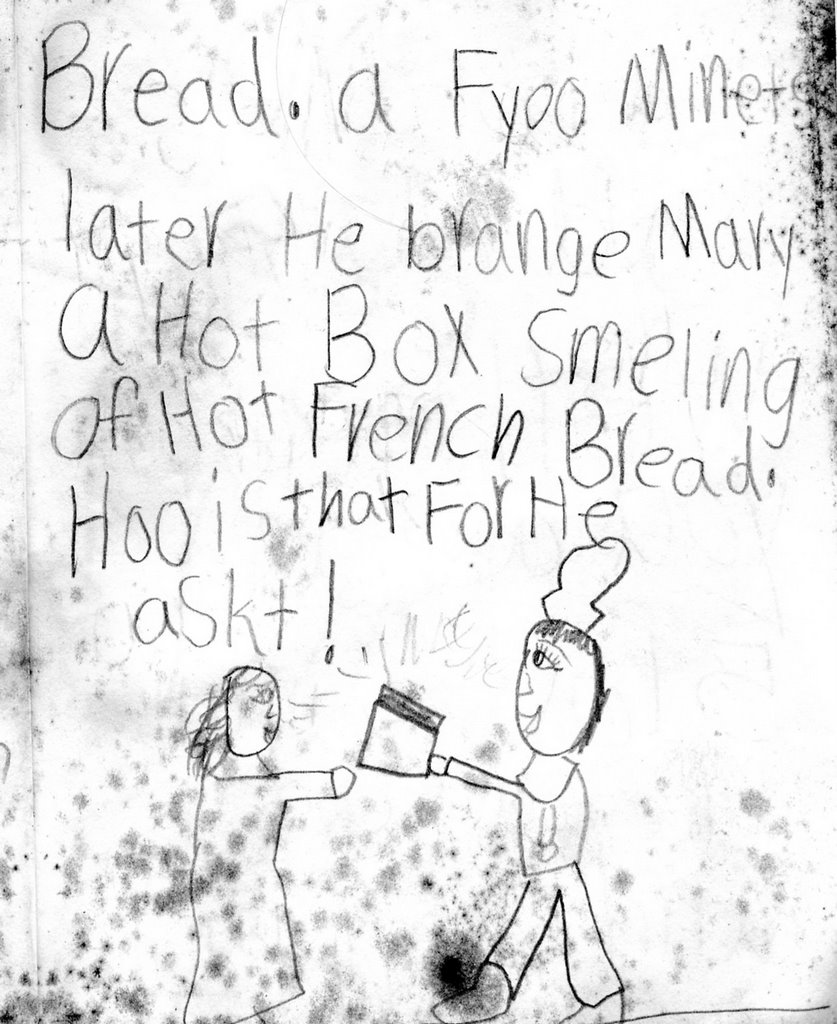
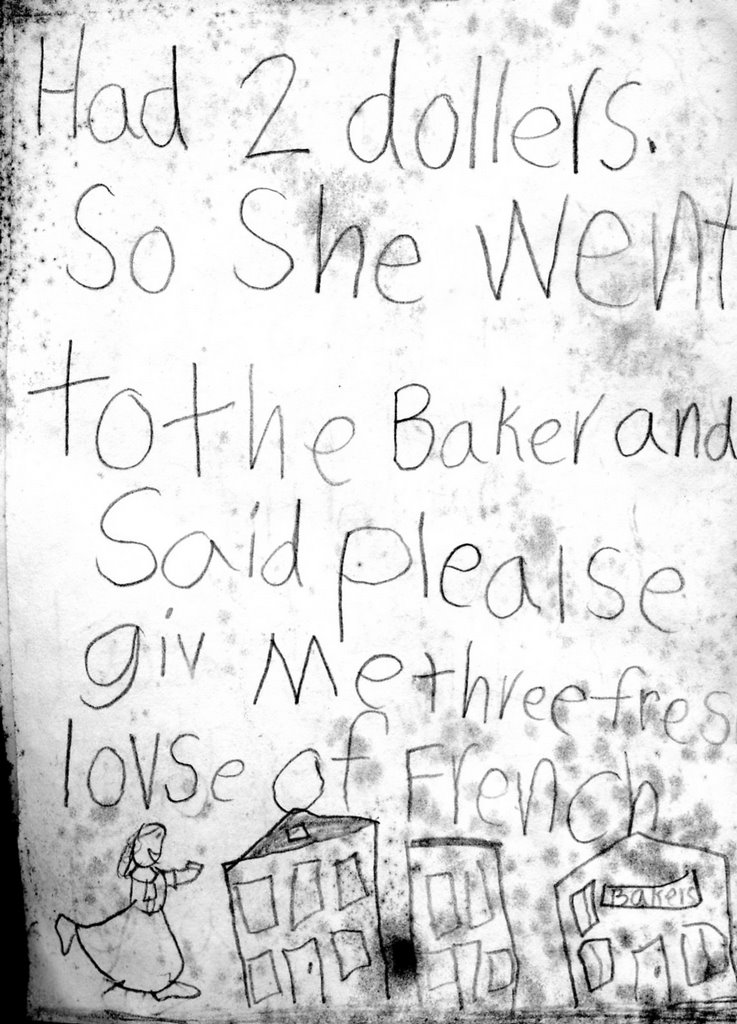
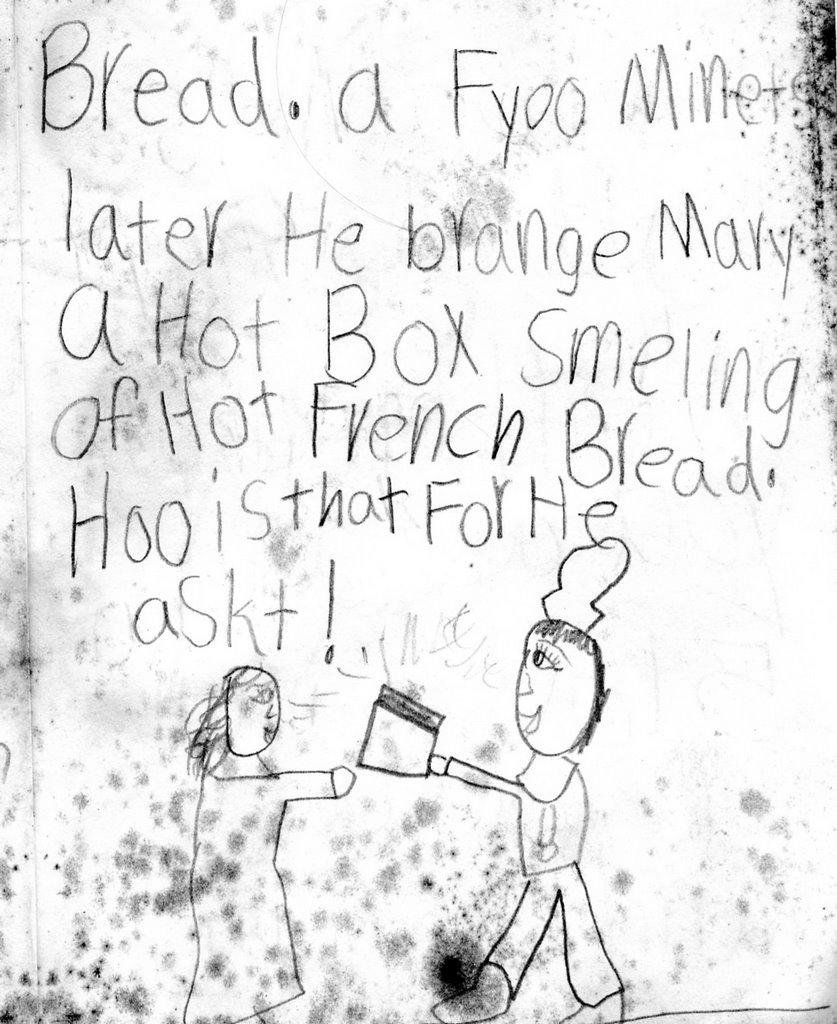
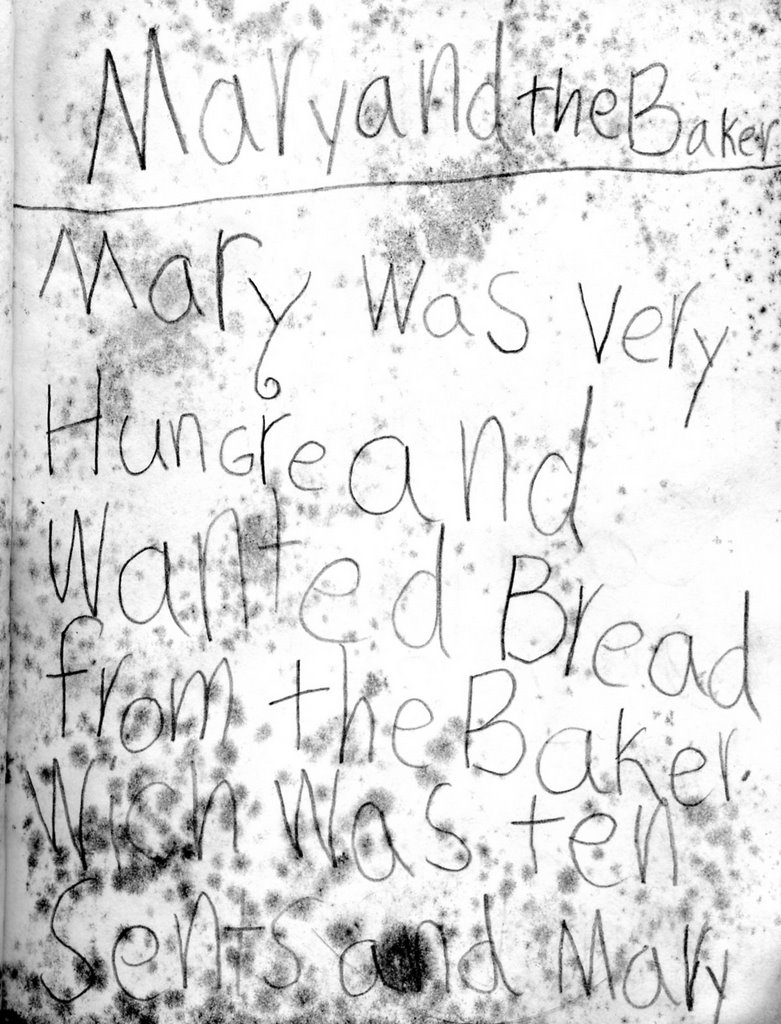
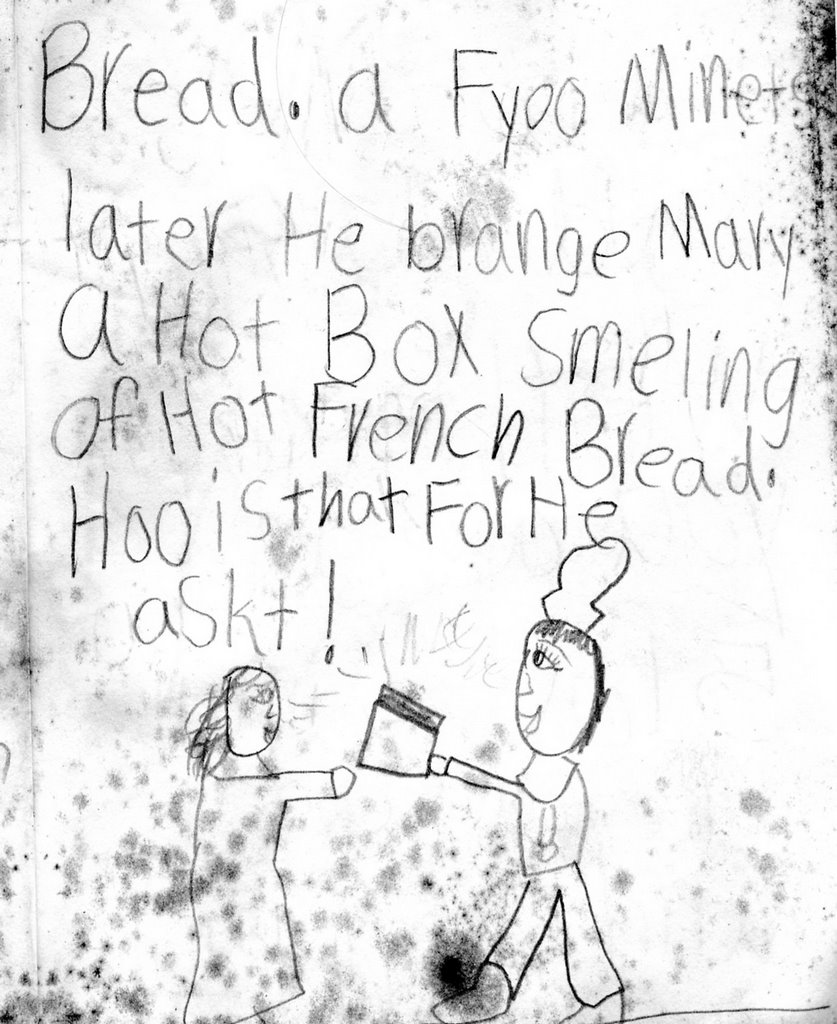
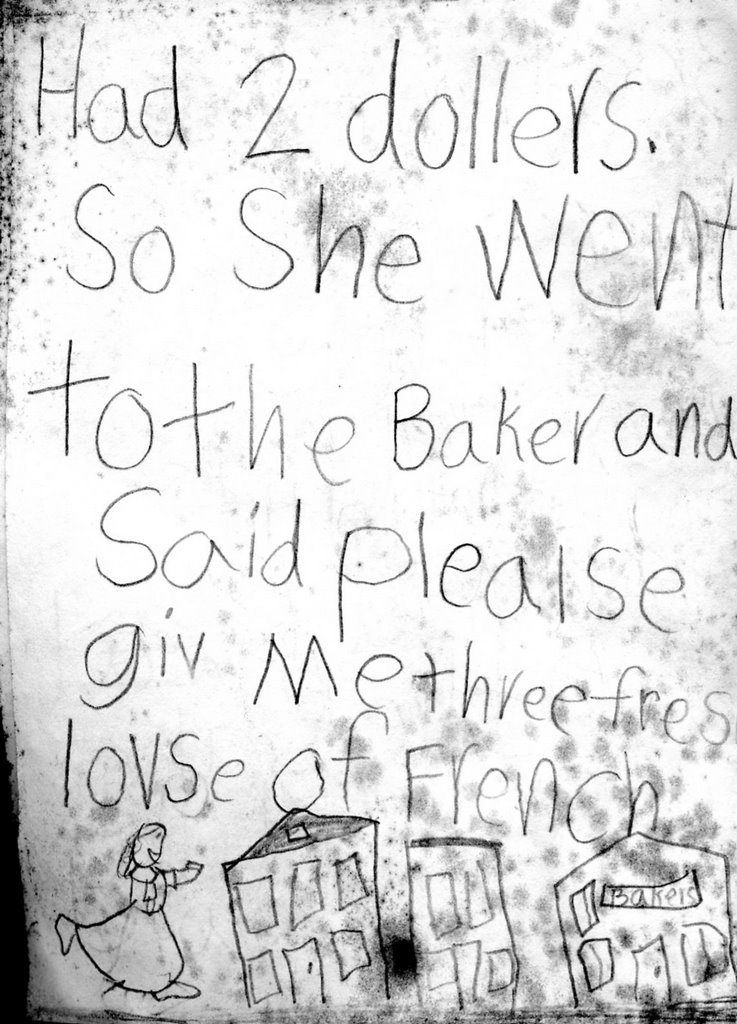
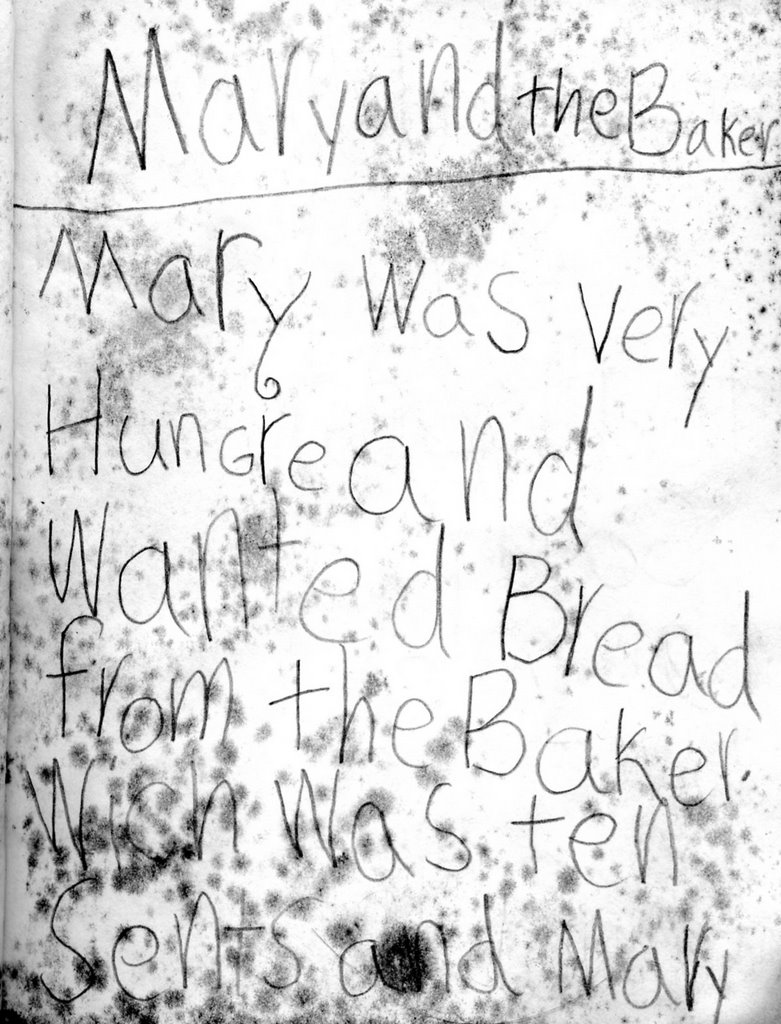
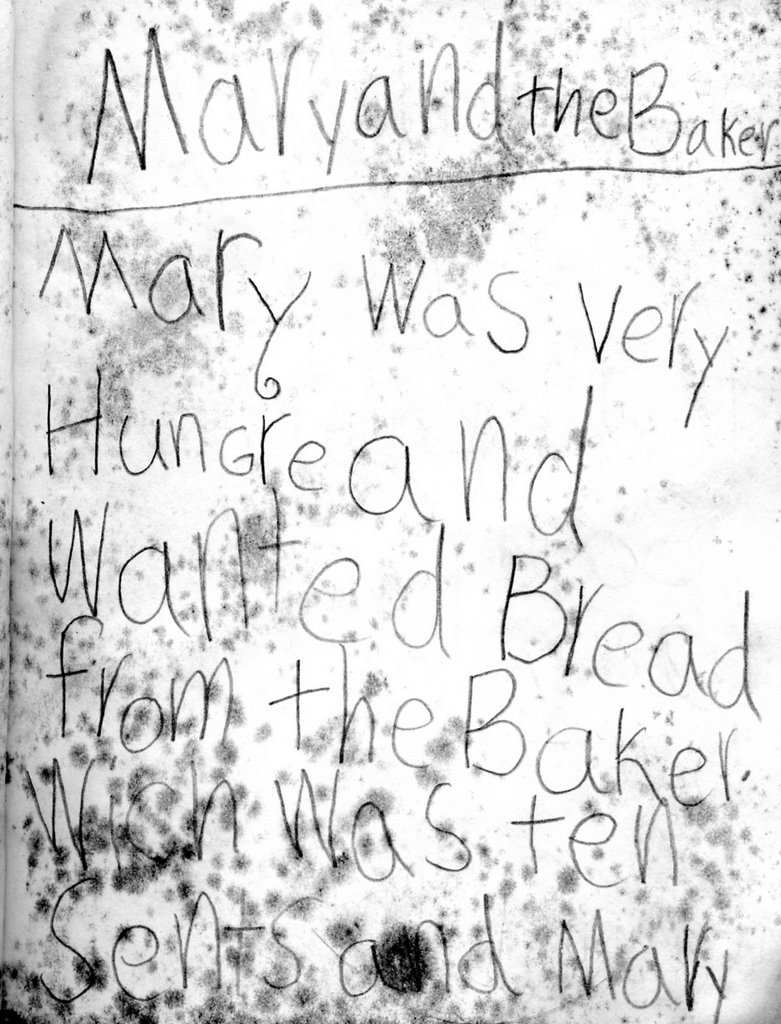
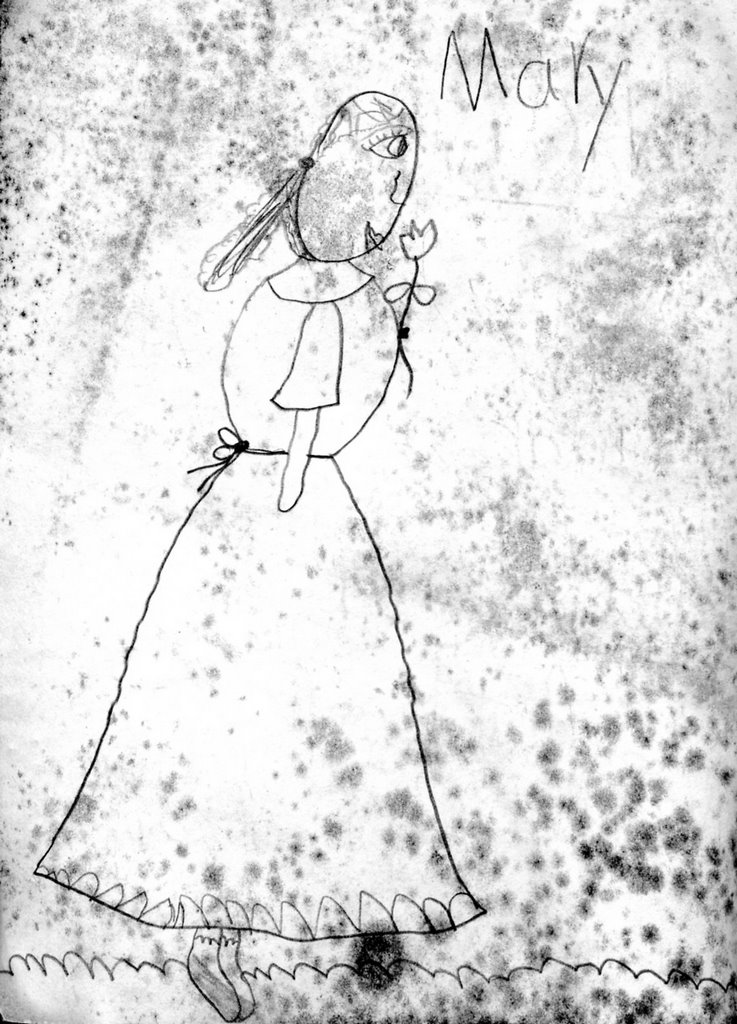
It is a story I wrote when I was, judging by the handwriting and spelling, quite young. Oh and sorry about the strange placing of the pictures, Blogger doesn't work to well with lots of images. I hope you can figure out the order. So there is the story. And in case you can't read that it says:
Mary and the Baker
______________
Mary was very Hungre and wanted bread from the baker wich was ten sents and Mary had 2 dollers so she went to the baker and said pleaise giv me three fresh lovse of French Bread a Fyoo minets later he brange Mary a hot box smeling of hot french bread. Hoo is that for he askt!it`s for me said Mary. Well here you are and 5 lovse in all like you said and they lived happily ever after!
________________

That's the spelling I used then I hope you can understand it. BTW the end page is not shown here, it didn't fit, but you heard what it said!

Wednesday, November 01, 2006

Beauty and the Beast, and Other Fairy Tales

A few months ago my dad read Beauty and the Beast from the Blue Fairy Book outloud to us. And since then I have decided that Beauty and the Beast is one of, if not my favorite, fairy tale. The reason is this: Beauty and the Beast have a reason to fall in love. In the typical fairy tale the hero and heroine fall in love seemingly on the spur of the moment or because they like the other's looks. Well I suppose Beauty does't have the problem of falling in love because of the Beast's looks, although he might have that temptation. But anyways, Beauty and the Beast have long talks every night and they get to know each other before they fall in love. This is true to a certain extent of Snow White and Rose Red as well. But in that one they play with the Bear more then have talks with him. By the way if you're not familiar with Snow White and Rose Red you can read it here. If you're not familiar with Beauty and the Beast then I suggest you go to the library in the near future.
So anyways any thoughts on this???? Any amendments to what I said??????

Tuesday, October 24, 2006

ANOTHER meme

My mom tagged me for the ten random facts meme, so here goes:
1. I LOVE reading, especially Chesterton, Tolkien, Lewis, Jane Austen and Regina Doman.
2. I've made several names for things that have stuck: our mudroom is now the cloakroom, a certain type of baby clothes is "kick-arounders" and swim suits are "dim duits"(that was when I was really little).
3. I have been doing Irish Dancing for five years now and love it.
4. I love memorizing poetry, I'm currently working on The Ballad of the White Horse and Lepanto both by G.K. Chesterton.
5. I was planning to go to ChesterCon this year, but Chicken Pox sadly prevented me from going.
6. My favorite branch of Science is Geology, particularly Archeology. I have always been interested by fossils, ruins and the like.
7. Although I don't much like math, I do like long division.
8. I just joined "The Dead Language Latin Club" after 4 or 5 years of Latin, and had a ton of fun at the first meeting. Perhaps I will post on it in future.
9. My favorite saints when I was little were St. Dominic of the Rosary and Saint Therese the Little Flower. (I still really like them of course:)
10. I began the "Great Vocabulary Project" by writing down a list of most of the great big words they spell in Akeelah and the Bee. Some of my favorites: prestidigitation, Merovingian, bioluminescent, Scherezadian (I'm not sure of the spelling on that one) logorrhea.
And I will tag: GilbertGirl, mysticalrose_84, Jenny, electroblogster and The Map Guy